
by Roger Casals
Here are some recollections about Yasha Eliashberg, shared from a personal viewpoint. I hope they provide a glimpse into Yasha’s impact on the younger generation of contact and symplectic topologists around him, as a unique mentor and an exceptional mathematician.
Introduction
(1) Facing the core of the problem directly. Yasha has an uncanny ability to filter out mathematical noise and point to the simplest case that needs to be solved. Also, this simplest case usually has a geometric solution which, through its visual appeal, simplicity and elegance, hits you like a train head-on when you find it. Once you see it, you know it’s the “right” solution, otherwise you keep on thinking.
It can be amusing to see Yasha’s expressions when one explains a (too) convoluted idea to him: his oscillating eyebrows, his squinting eyes and the tilt of his head (first) and then his body are all clear signs that we are getting farther from the simplest case to be understood. Then Yasha gently interrupts and says something like “What about this?”, indeed highlighting the important case.
(2) Thinking for yourself. I admire that Yasha is open to new ideas and wants to understand results of other people. That said, I am inspired by the fact that he strives to understand these results in his own words. I have sometimes talked to him for hours discussing a proof, and his endurance and will to keep talking until he gets it (in his own terms) is remarkable. It is even to the point that once he understands something about my new theorem, then I too learn something new about my theorem! This has also made me appreciate how much hard work and passion for mathematics lie behind Yasha’s remarkable results and insights.
(3) Being generous with your time and ideas. This is probably my favorite of Yasha’s traits: his door has always been open to me, and whenever I have seen anybody ask to talk to him he will always make time for that. As years pass, I appreciate all the more how he puts in the effort to make himself this available and how open he is to sharing his insights and ideas. By any measure, he is a “giant fish” in our mathematical ocean and yet he is approachable and engaging (he has a really good sense of humor) both to junior and senior colleagues, whether he meets them for the first time or has a long acquaintance with them.
First encounter
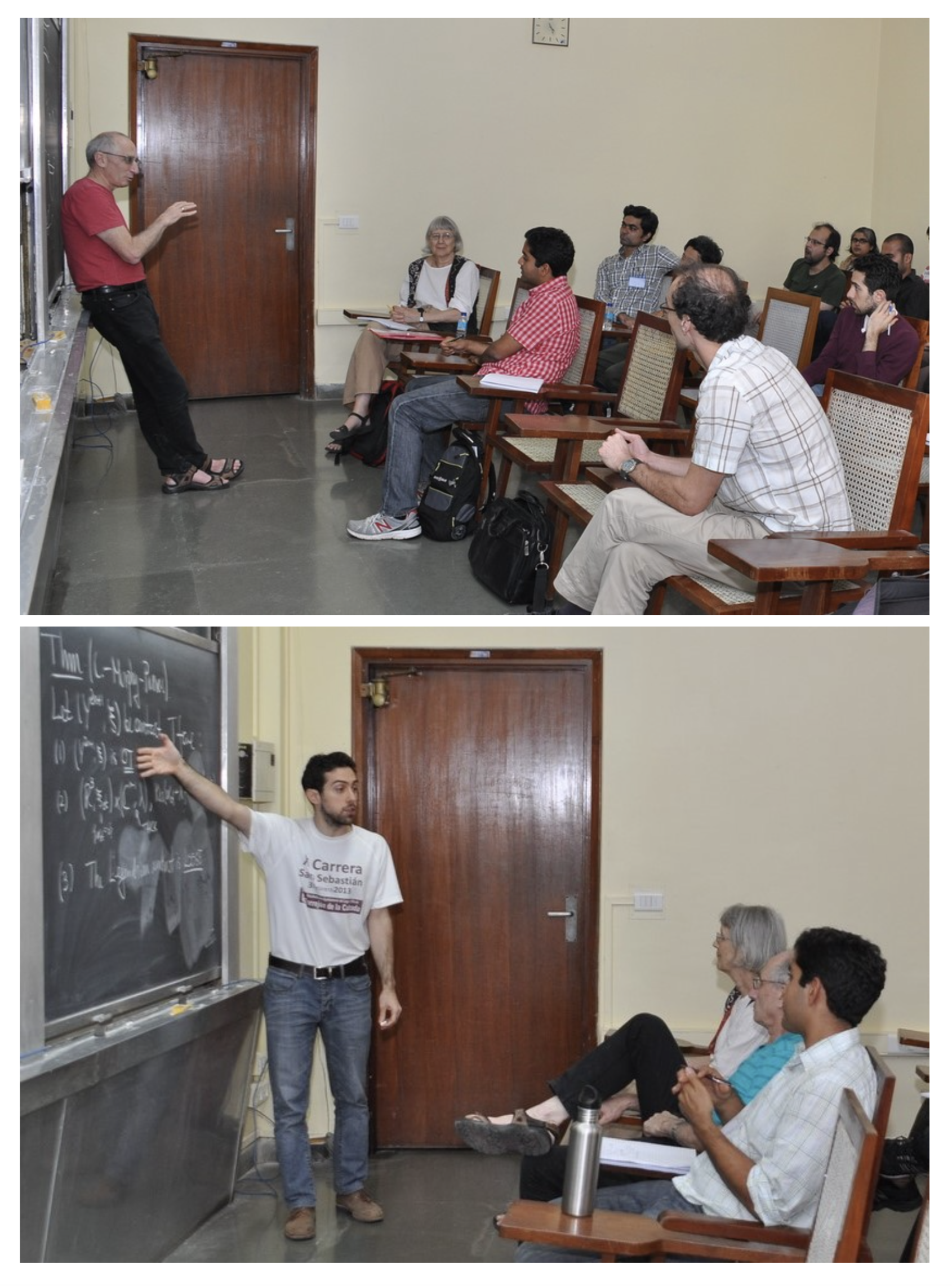
Breaking the structure of the talk in such an insightful manner gave rise to a much better discussion on the problem and the solution. For more than a decade, I have witnessed how engaged he is in talks, how he tries to unravel the point of a new result. I find Yasha’s ability to cut through the noise and get to the core of a problem to be freeing and inspiring; it lets one break from the shackles of preconceived ideas, wrong intuitions and algebraic biases. To me, listening and talking to Yasha sometimes feels like swimming in the ocean, less bound by the tether of solid ground and ready for a buoyant new world of possibilities.
Leading forward
In March 2014, after having worked on the five-dimensional case, I focused my thesis on the general case of existence of contact structures. I had found being near Yasha in 2012 so productive that this time I visited him through the entire spring quarter of 2014. I flew to San Francisco from Spain the week of March 27th: I remember that date because the day before my plane took off I saw that Yasha had first announced a talk titled “All manifolds are contact except those which are obviously not”. I knew he had cracked open that \( h \)-principle and I also knew how. Back in 2012, Yasha had explained to me his strategy (with the immersed disk picture) and what needed to be done: I had been trying my own way for those two years with “newer” techniques but he then shared his fantastic proof, teaching me an important lesson. Indeed, his argument mainly contained “classical” ideas, the type of ideas and techniques you could already find in his book on the \( h \)-principle and in his previous papers: what was remarkable about his proof is that he had been able to take all those classical ideas, refine them (truly teaching us what they were about) and put them together in a masterful way, obtaining the desired result. This front-seat view to his craft was a gift: learning the value of revisiting and elevating the basic pillars of our field (manipulating contact Hamiltonians and contactomorphisms, understanding orders and metrics, etc.), staying cautiously away from flashy new trends, and focusing on understanding those concepts that we constantly use at a deeper conceptual level.
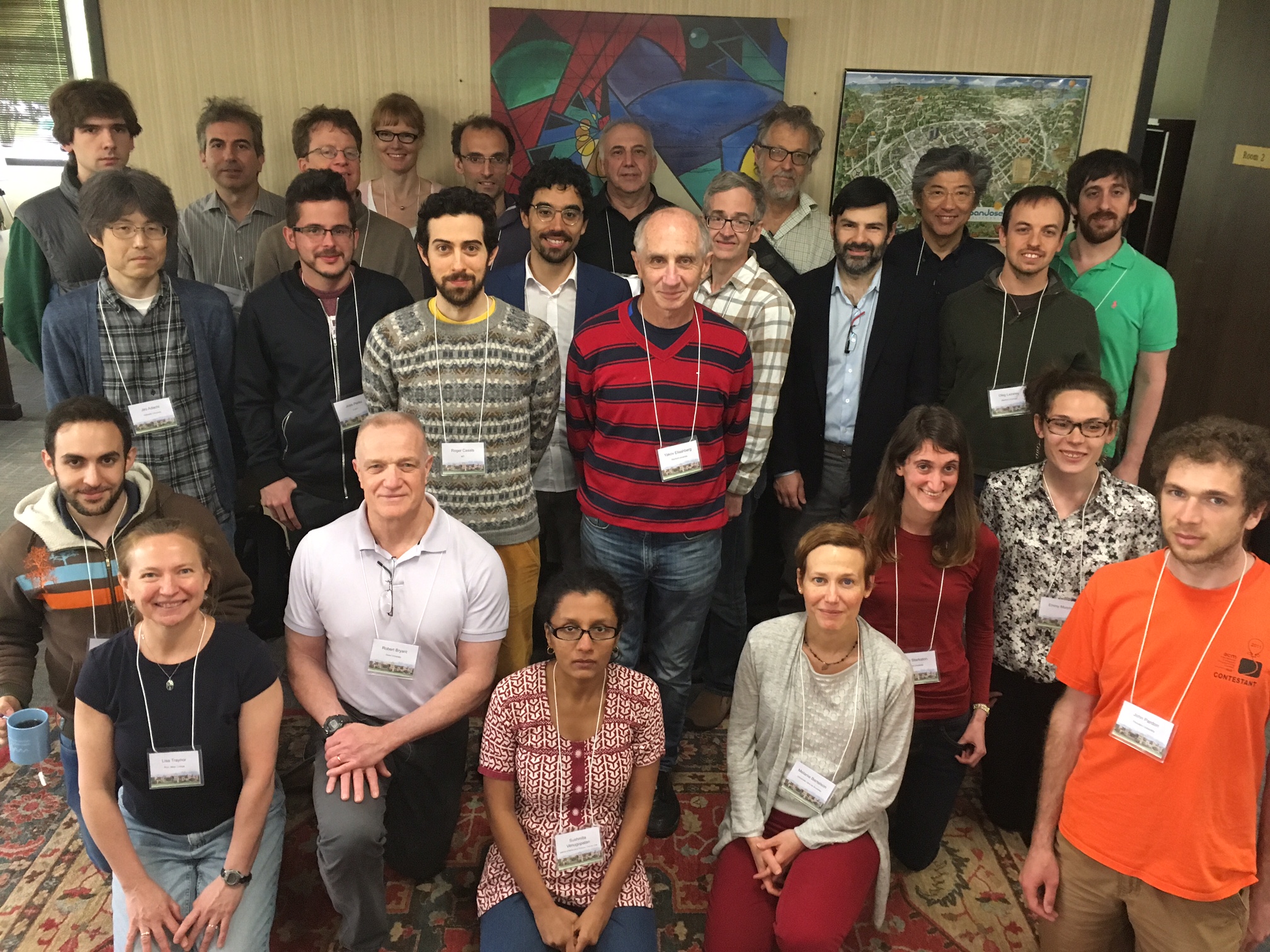
To this day I remember the stirring confusion I felt at that time: Yasha had crushed my research program but I was ecstatic about his new result. Yasha helped me seize that moment and make it a positive turning point. Indeed, we kept meeting weekly and I vividly remember his enthusiastic energy towards the mathematical future: even though Yasha had brought forth that remarkable proof, he mostly wanted to talk about what came next! For him, it was all about tackling new open questions, simplifying new ideas and building forward a new research program. That was the first of many times where I would see Yasha’s leadership in action: how he dared to ask new exciting questions, with child-like naivete, and create new directions of research from scratch.
In fact, that spring of 2014, with Yasha and Strom Borman (then an NSF postdoc at Stanford), I saw the inception of the geometric criteria for overtwistedness, which became an important part of my (new!) research program. On July 29 of that same year, Yasha and I were both walking in London and chatting about what could be next for contact topology. At some point, Yasha smiled at me and said, “You know what other conformal geometries are there?” We both smiled and said, “Engel structures”: and that was that! There followed three years of new exciting developments on Engel structures. (Yasha very kindly organized an AIM workshop on them in 2017.) Through many such interactions, Yasha taught me how to build from the ground up, believing in one’s own ideas and mathematical interests: not by jumping on somebody else’s (mathematical) train or by being constrained by other people’s opinions, but rather by investing in one’s mathematical vision and pursuing it with passion and hard work.
Communication and community
There is something unique about the way Yasha communicates mathematics. His pictures on the blackboard (or hand-waved in the air) sometimes remind me of the abstract work of artists like Kandinsky or Miró, and yet he has this effective way of transmitting the essence of a picture to one’s brain.
For instance, one day Yasha was excitedly telling me about a certain proof for an \( h \)-principle, drawing a picture on the blackboard in his office. The phone rang and he answered speaking in Russian. Moments later, he hung up the phone and continued telling me about that proof with equal focus and passion, in Russian. Even though I speak no Russian, for a few moments I managed to get most of it, by means of his pictures and gestures. Yasha has a rare ability to transmit images from his brain to an audience: it is not really about the exact words he says or even the precise picture; rather, there is a certain essence to his delivery that, when you tune to the right frequency, makes one’s mathematical soul vibrate.
Once during a conference in the Île de Houat (France), a few children from the local elementary school visited the conference during a break. (Meeting mathematicians in the wild, what a field trip!) Yasha was particularly welcoming to them, and one of the kids asked him something like “What do you do in this job?” Then Yasha excitedly started to explain to them Nash’s \( C^1 \)-embedding theorem: he had the kids mesmerized with the explanation. It was a brave choice of topic to present to an audience of six-year-olds, and it was quite a sight to see Yasha impressing on them “It is very very close to the original embedding, but there is no curvature obstruction because it is not \( C^2 \)!”, always with a smile and the type of engaging enthusiasm that instinctively gets kids’ attention.
Yasha has been a pillar of the contact and symplectic topology community over the years. I hope that what I’ve shared here helps readers appreciate his unique qualities. There are certainly many more anecdotes and fun facts to know about him: just ask people or, even better, spend some time around him. Through his decades of advice, conference organizing and editorial work, Yasha has helped tens of other mathematicians flourish in his area of research, and I frequently see his mathematical influence in the work of his former students (he has more than 91 academic descendants!) and in that of his postdocs, even years later. Maybe the simplest proof of his impact is to discuss some central problem in contact topology with an expert: I suspect it will not be long until you hear “Talk to Yasha”.
Roger Casals is a professor at the Department of Mathematics at the University of California at Davis. He grew up in Barcelona, where he majored in mathematics at the Universitat Politècnica de Catalunya (2011), and pursued his masters and PhD studies at the Universidad Complutense de Madrid, the Universidad Autónoma de Madrid and the Instituto de Ciencias Matemáticas (ICMAT-CSIC). He moved to the United States to become a CLE Moore Instructor at MIT in 2015, and later became a professor at his current institution.
